Language, memory and finding belonging: A conversation with Yirga Gelaw Woldeyes
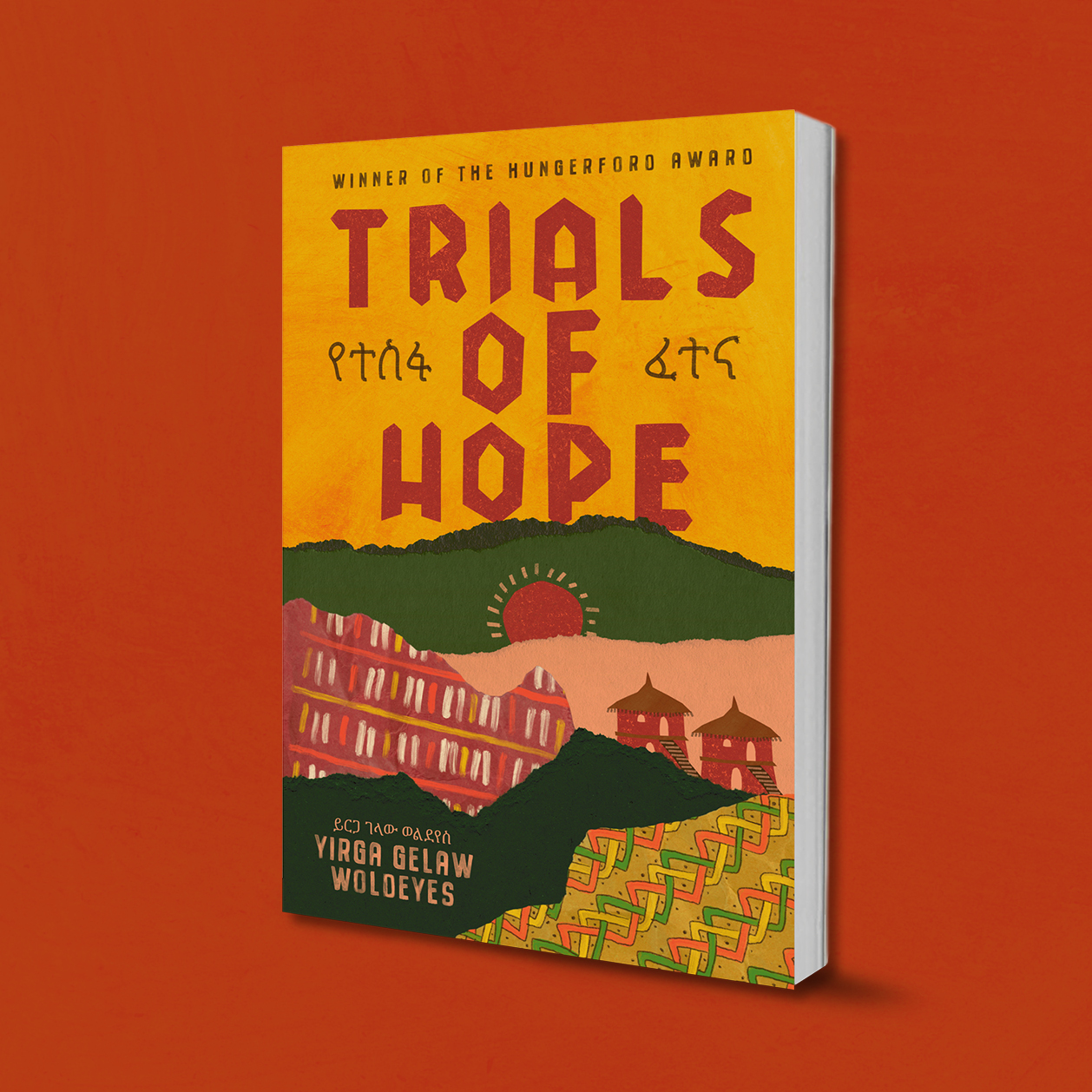
Winner of the 2024 Hungerford Award, Trials of Hope (የተስፋ ፈተና)is a groundbreaking bilingual memoir that challenges how we think about belonging and language. Author Yirga Gelaw Woldeyes weaves together poetry and prose, Amharic and English, to create a deeply moving account of Ethiopian heritage and displacement.
In this interview, Yirga discusses the craft behind his unique memoir, the importance of keeping language alive, and why Trials of Hope (የተስፋ ፈተና) is an important Australian story.
Which did you write first: the poems in Amharic or English? The prose or the poetry?
I wrote the poems first. In fact, many of the poems were written across decades. From my childhood in Lalibela, to my time as a health assistant across rural Ethiopia, all the way through to my life in Australia, I wrote versions of the poems that appear in this book. I write when poetry strikes me, wherever that may be. For instance, when I was a security guard, from midnight to daybreak, my body would cross buildings and lawns, but my mind often invented poems. I created a small notebook similar to the security notebook we were given to record incidents, just for jotting down lines or even whole poems. To me, the poem is like the spirit or soul, while the prose is the body or the clothes. The prose is there to hold up the poems. Except for maybe one poem, I never write in English first. I write in Amharic without thinking about the English. Amharic poetry has strict rules. If you carefully look at the end of each line, you can see that many of the last letters match. This is because Amharic poetry must rhyme. I always feel free when I write in Amharic; translation happens after.
Were there challenges in re-entering and giving shape to the memories contained in these pages? Did you discover anything that you did not anticipate in writing them?
My memoir is full of gaps and absences. Some stories unrelated to the present were abandoned, while less important stories in my past were picked up, mainly as illustrations for the points I’m trying to make about African heritage, colonialism or belonging in Australia. For example, the story of the African-American professor talking about black consciousness was marginal to my life. Yet, it became central later because I understood what she meant after I came to Australia. I also did not understand the uniqueness of my upbringing, or the value of freedom I enjoyed as a child, until I was an adult living in another country. We truly belong or feel free when we are not conscious of our belonging or freedom, when it is just a fact of life rather than something contested or needing to be claimed. When I re-enter and give shape to memories, I am doing that from the perspective of today, from where I stand today and what I want to tell the world.
Why is this an important Australian story?
My book may be different from the usual Australian story, but this difference is what makes it an important Australian story. Some may think that what makes the book exceptional is the inclusion of Amharic, a foreign language. But Amharic is not an exception. English too is a foreign language to this land. The book disrupts the attitude that considers Amharic as foreign but English as native. It also reminds us that in this country, not all languages are equal citizens. If there is a European way of becoming an Australian, shouldn’t there be an Ethiopian way of becoming an Australian too? How would these different forms of becoming Australian coalesce into each other if our relationships were to be guided by Country? You cannot erase 60,000 years of history with a 200-year-old fable without committing a terrible crime – the crime of terricide – where the land is not allowed to nurture and give birth to diverse cultures. Instead of seeking belonging from institutions and laws, I seek citizenship from the ‘Kole’, from the ancient spirit of this land. That is an Ethiopian way of becoming Australian.
You have a bilingual son. Have you been able to find books here in Australia written in Amharic? Why is it personally important to you to keep your language alive?
I haven’t been able to find any books written in Amharic in Australia, and even the books that come from overseas are mostly poor translations written by non-native speakers. As a result, I have resorted to translating many of my son’s English books, writing directly onto the books themselves. I also write entirely new stories in Amharic for him, trying to merge his interests with stories from Ethiopia. I have only ever spoken to him in Amharic and, as such, he has two mother tongues: Amharic and English. We swim in these two languages in our household, our son effortlessly switching between the two.
It is important to keep my language, and all languages, alive because each one contains an entire unique universe. Language represents what people feel, experience, know, believe, love, fear and hope. Even the same language does not represent identical realities. Language allows us to live in plural universes; it helps us imagine, invent, remember and forget. In my tradition, it is one of the attributes of our soul. It is the lifeline of generations. Denying one’s language is killing the spirit of the ancestors: their memories, their histories and their lifelines. It harms all of us. Colonial languages implant the memory of the coloniser into the culture of the colonised. As such, it’s very important to keep one’s native language alive. It is a responsibility my wife and I take seriously, and we are raising our son as bilingual to connect him to the spiritual, cultural and epistemic heritage of Ethiopia. It is his birthright.
What is next for Yirga Gelaw Woldeyes?
For my next book, I plan to focus on the situation in Ethiopia over the last few years with the civil war and ongoing ethnic violence. I want to bear witness, to record what has been largely unrecorded, seen or felt by the western world. The atrocities are directed at the heart of Ethiopia, not only harming individuals and communities, but the webs of relations that bound Ethiopians together back home and here in the Australian diaspora. These records will be accompanied by poems and reflections.
Trials of Hope (የተስፋ ፈተና) is available now from all good bookstores and online.