Unearthing buried truths: Author David Price on writing about WA’s haunting past

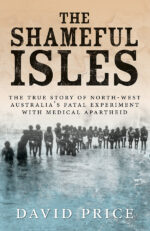
In his latest non-fiction book The Shameful Isles, author David Price uncovers a dark chapter of Western Australian history. In this interview, David tells us about how he first learned about the events that took place on Bernier and Dorre Islands, and the research that went into creating this deeply moving account some of our state’s ‘hidden’ history.
Can you tell us more about The Shameful Isles and what sparked the writing of this book?
This book is about events that took place in the early part of the 20th century. It tells the story of a government initiative to forcibly relocate hundreds of Aboriginal people from across the state to ‘lock hospitals’ on two remote islands off the Gascoyne coast of WA. The ostensible aim was to eradicate venereal disease although, in the light of modern science and the fact that ‘diagnosis’ and the capture of patients itself was often done by medically untrained men, there is some doubt now about the exact nature of the disease. The impact on the prisoner-patients, however, was tragic; they were taken from their people, their families and their country, involuntarily treated with drugs and scalpels, often used as slave labour on the islands and held captive until their cure or their death. More than 150 Aboriginal people are still buried in unmarked graves on the islands. Many more never found their way home.
I was about 10 years old when I heard this story from my mother, albeit somewhat sanitised (she thought the disease was leprosy and the whole affair driven by kindness). She had lived in Carnarvon all her life and had heard the tale from her mother – a settler in the town when the events were unfolding. I’ve since learned that the story was also passed down through successive generations of Aboriginal children but rarely talked about openly. Although my teachers at the time were sceptical and quietly dismissive when I relayed the story to them, the image of those islands lay present but dormant in my mind for decades. One day, while doing some family research, I came across references to the lock hospitals in a newspaper account of the time and my interest was rekindled. The Shameful Isles is the result.
What challenges did you face in researching and accessing historical records about the lock hospitals, and were there any particularly surprising or difficult discoveries that shaped your understanding of this history?
The thing that surprised me most was that a significant amount of research, articles and commentaries already existed in relation to the lock hospitals of WA. Carnarvon, from where the island patients were shipped to the islands, has made an impressive and highly visible attempt to bring that part of history alive in the form of exhibits, heritage trails and even a unique, poignant statue overlooking the ocean. And yet most people I meet are still surprised and shocked to learn of the tragedy.
From this I learned that our somewhat narrow view of WA history is not so much a product of lack of information; instead, it is a failure to lock that information into the public consciousness in anything but the most superficial of narratives. Remedying this has implications for politicians, our education systems and our media. We cannot expect the public to be sympathetic towards a past that is largely a mystery to them, or to understand a people whose history is mostly hidden.
The other lesson that came home to me in the writing of the book was an old one: that any single individual is capable of evil but to commit wholesale evil takes an entire public service. It is salient to remind ourselves of Hannah Arendt’s axiom that ‘the sad truth is that most evil is done by people who never make up their minds to be good or evil’. While it is tempting to look for individuals or groups of people to blame for what happened on the islands and what followed – politicians, squatters, policemen, doctors – the fact is that it was ordinary career public servants who turned the banal and unremarkable wheels of bureaucracy towards the efficient achievement of racial exclusion and separation. Not one of them would have thought they were doing any more than their jobs, and none of them set out to do anything other than carry out the will of a democratically-elected government.
That is the great subtle truth of WA’s history with Aboriginal people, so much more deadly and persistent than even the massacres, rapes and stealing of land. The days of trying to identify ‘goodies and baddies’ in our history must come to an end if we are to tend the wounds of the past. It was then, and it is now, the responsibility of all of us ordinary, everyday people.
How did you approach balancing the different perspectives in your research while ensuring the voices of Aboriginal people remained central to the narrative?
In the end, it was difficult to find the voices of Aboriginal people and, even when I did, these were often filtered through the voices of white interpreters, court reporters, bureaucrats and journalists. However, whenever I found a genuine voice of the First Peoples, I tried to represent it as fairly as possible within the constraints of the medium. In the end, I have tried to tell the story in such a way that language is not a prerequisite for understanding. When it comes to tragedy, knowing any human being is to know all human beings. All the manifestations of sadness, pity and pain that are at the centre of this story – dispossession, estrangement, loss, death and dying – are the shared lot of all of us, irrespective of the language we speak or the things we believe.
Even so, I am conscious that The Shameful Isles is inevitably a white man’s view of what his people did to another people with darker skin. I will leave it to Aboriginal people to tell the tale from their perspective. In the long run, I think we will all benefit from having access to both perspectives.
How do you see this historical episode connecting to contemporary issues facing First Nations peoples in Western Australia today, and what do you hope readers will take away from learning about this history?
Just as the child is the father of the man, so a nation’s past is the parent of its present. In today’s society we still find the genes of the islands in our modern DNA: it’s easy to draw a straight line between the worst of those times and the worst of these – the incarceration rates, the children in care, the gaps in education, employment and health, and the lowered life expectancy. But most of us prefer to silo the roots of such sadness into a box marked ‘then’ and spend most of our time pointing our fingers at the ‘now,’ as if they are in no way related. I don’t know why we are like that. Maybe if we draw too clear a line it feels like we are owning the problem and the cause. Maybe it is just easier to say things like, ‘Well, that was all a long time ago. Get over it and move on’. Recently I heard a prominent WA federal politician suggest that Aboriginal flags are a threat to Australia’s sovereignty. Just a few days ago, politicians in Canberra turned their backs on Welcome to Country. I hope that readers will take away from this book a sense that comments and acts like this not only hurt Aboriginal people, but hurt us all because they still refuse to acknowledge the most fundamental of truths: our great country was once someone else’s and we took it from them. Aboriginal people could choose to hate us for that, but all they ask for is the chance to welcome us and to fly a flag. It seems so little to ask, don’t you think? And so generous! And yet some of us hate them for that.
The Shameful Isles is available now from all good bookstores and online.