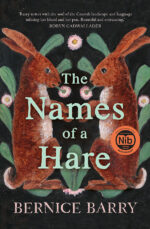
Author Bernice Barry talks about how a mystery woman on a cliff sparked a sweeping historical fiction novel
In 1869, R.D. Blackmore wrote about romantic heroine Lorna Doone. Years later, Bernice Barry has reimagined the lives in the book in The Names of the Hare, delivering a historical fiction novel about a girl with a knowledge of herbs becoming a woman among the witch hunts. In this interview, Bernice tells us more about how she was inspired by Lorna Doone and the detailed research that went into the writing of The Names of a Hare.
Can you explain to us the connection between R.D. Blackmore’s 1869 novel Lorna Dooneand the work you set out to write?
After receiving a copy of Lorna Doone as a school prize when I was ten, I was more interested in the mysterious woman who lived on the cliff than in any of the main characters. I wondered how she ended up there and where she came from, so when I decided to write a book set in Cornwall, and discovered that Blackmore’s ‘Mother Meldrum’ was based on a real woman who came from the region, things fell into place – more so when I learned she had many different names, just like the protagonist in my own book!
The events in Lorna Doone are significant memories from her past life, but I didn’t want the story of the Doones to overshadow hers, so I created a few points where the two plots connect, gently (I hope) hooking two stories together. The tale told by John Ridd in Blackmore’s book offers additional background for anyone who wants further reading.
What kind of research did you do? Did your research influence the novel’s direction in any way?
I enjoy historical research as much as writing. I used the same kind of sources as usual to connect with the time and place (contemporary maps, literature, portraits, old books and parish records) but the 17th century setting was new to me, so I had to start almost from scratch on details for clothing, food, activities, local and national events, even choosing names for my characters.
I make use of books on cookery and domestic management, because they not only provide the words used for everyday objects and ingredients, they also somehow create the actual smell of a kitchen or a bedroom of the time. It’s very immersive!
I studied contemporary publications on the Cornish language, proverbs and sayings of the west country, and superstitions connected with trees and plants. While I was writing, I had to keep checking that the words I was putting in my protagonist’s mouth were actually in use at the time.
I also read widely on magic, herbal lore and medicinal remedies. That definitely led parts of the novel in directions I hadn’t planned, because it was so evocative. Images of scenes came into my head in an almost cinematic way. For example, when I came across the instructions for the hot paste of wild oats used for pain, I realised what an intimate situation it would be if that was applied to Ned’s stomach, a way of showing the beginning of a relationship – and that’s where the scene came from.
Do you think that the genre of historical fiction offers readers a kind of solace, a way of seeing ourselves – or perhaps something different altogether?
I think that describes the possibilities for reading fiction generally. A character who has something in common with you can be reassuring, but someone quite unlike you can be thought-provoking in a good way. Am I like her? Could I be? Fiction is such a good way to experience imaginings and possibilities, exploring the ‘what if …?’ of our own lives, but perhaps historical fiction offers a safer scenario, seeing ourselves (and our own potential for good or bad) in a landscape more distantly removed in both place and time. There’s also the wonderful juxtaposition of familiar and unfamiliar. Homes, clothing, domestic details, all intriguingly strange, and yet the people, even hundreds of years ago, struggle with the same issues that we do today. Observing change over a long period of time, through fiction, can certainly be a kind of solace because we tend to seek out patterns, and it’s reassuring to know that some important things never change.
What is next for Bernice Barry?
I’m definitely hooked on writing fiction now, and already have the skeleton of a new novel in my notebooks, but I’ve learned that to enjoy writing I need a real person at the heart of the plot, someone who lived, someone with a story to tell. I loved writing about Cornwall, those wild, beautiful places vivid in my memory, so I hope to use that setting again. I really enjoy using a first-person voice, because it pulls the reader and the protagonist so closely together. I also like the idea of trying to write about a relationship from the viewpoint of a man, and that feels like a good personal challenge for my next book!
The Names of a Hare is available now from all good bookstores and online.